

Long easy/moderate runs are endurance training, where you become able to run far in a long time. Finding your Lactate Threshold and practicing LT – training, you become able to run faster i.e. with a higher intensity for a long time. In other words, by performing lactate threshold training which is intensive marathon training intervals, you learn to run faster and longer. We will explore how the lactate threshold boosts your marathon performance below.
🧪Lactate Threshold – What Is That?

Science has shown more precisely, what causes the accumulation of lactate in the working muscles during hard work. But in general, the Lactate Threshold – LT is a very reliable and powerful marker of performance in aerobic exercises because it works in practice. Lactic acid or just lactate is called a waste product of energy production. It paralyzes the muscle and causes a burning sensation.
The lactate threshold LT is a threshold where a given work intensity leads to the lactate volume in the muscles beginning to rise pretty much. Lactate produces continuously with muscle work. However, if there simultaneously is sufficient Oxygen, excess lactate will be removed via the blood.
At low work intensities, there is a balance between the production of lactate and the elimination of lactate. The lactate threshold or just LT is thus the highest level at which a stable level of lactate can be maintained.
It means that the production and removal of excess lactate in the blood are equal. LT is therefore at the intensity level, where the lactate volume just does not inhibit the muscle work. When the work intensity increases, the lactate volume increases equivalent since a major part of the energy produces anaerobic.
Lactate accumulation leads to muscle challenges. The muscles paralyze and become more and more painful. It is therefore, necessary to reduce the working intensity and lower the pace to avoid further pain and discomfort.
👉 Read more about how endurance training develops the aerobic foundation needed for long-distance performance.
🚀Lactate Threshold Training
The ability to “move” the LT, so you can tolerate more improves by running nearby the LT. It’s also the level, where you best improve endurance. The most practical way to describe the LT level is on basis of the maximum oxygen uptake.
If you are a common jogger, your LT will probably be around 60-70 percent of your maximum Oxygen uptake, whereas the anaerobic threshold at very well-trained runners, will be between 80 and 90 percent of the maximum oxygen uptake.
👉 Read more about how lactate threshold training fits into a balanced marathon training program.
🩸Lactic Acid Blood Test
If you want to experience how the lactate accumulation feels, then try to stand up with your arms horizontally for 4 minutes, and you will experience how it feels. At one point, your arms begin to shake and pain, and finally, there is so much lactate accumulated in your arm muscles, that you simply must let them fall.
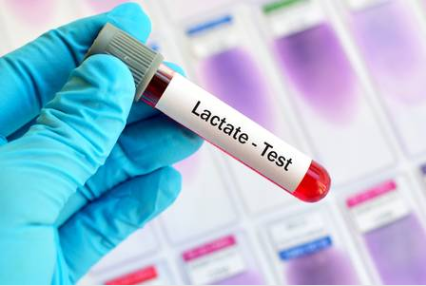
Lactate measures often in MMol per liter of blood. The lactate threshold theory compares the speed/heart rate with lactate accumulation in the blood. LT for the majority is measured to be about 3-4 MMol per liter of blood. The highest lactate accumulation a person can obtain is about 19 MMol per liter of blood.
As you see there is a lot to gain, particularly as a beginner who wants to improve your running skills. When we move our LT it means, that we run at a pace nearby our LT and hereby move it over time. In this way, we will run longer with a higher speed before the limit is reached.
👉 Read more about how oxygen utilization influences endurance performance and training adaptations.
🔬Lactate Threshold Testing
If you want to find your exact LT level, you have to be tested on a treadmill with modern laboratory equipment. An expert measures your lactate concentration at different speeds and finds the threshold exactly.
LT can also be found in some practical tests. For most people, the maximum speed you can run on a half-marathon will be similar to the pace at LT. If you have not run that far yet, you can use your 10 km time and add 8 – 10 seconds per kilometer. Let’s say you run 10 km in 50 minutes with maximum effort.
LT will then be, at an intensity corresponding to 5 minutes per. Km plus 8 – 10 seconds each km. Today you can get a Heart Rate Monitor – Sports Watch, and it is more convenient to use the working heart rate to define the LT and your other training zones.
👉 Read more about using heart rate zones to monitor training intensity and performance.
⌚Lactate Threshold Training Zones and Heart Rate Monitor Watch
Heart rate training with a Heart Rate Monitor is a training method where you continuously measure your heart rate, so you can stay in a certain heart rate zone, depending on the purpose of your training. This also allows you to control when the lactate threshold has been reached.
If you want to use heart rate training as preparation for a marathon race, you need to acquire a wrist-based Sports Watch or at least a Watch with a Heart Rate Monitor (HRM) either built-in to measure on the wrist or as a separate belt around your chest.

Correct performed heart rate training also has the benefit that you do not have to worry about whether you train optimally concerning your physical capability since you make two preliminary personal tests and enter the results in the Watch.
👉 Read more about using HRM in Practice to guide marathon training intensity.
❤️Lactate threshold heart rate zones
The HRM will reveal whether you are very tired, by an elevated heart rate at a given pace, compared to what it usually is at that given pace. Let’s say the HRM shows a heart rate of 150 beats/ min. on easy jogging! Then you probably have to take an extra rest day. It’s also easier to avoid overtraining and possible overload injuries.
HRM is a great management tool when running: your heart rate is a very precise target for training intensity, and when lactate begins to rise or fall, it gives certainty in daily training. All persons, from untrained to elite athletes, can benefit greatly from heart rate training because heart rate varies from person to person.
Thus, HRM gives you the best conditions for planning and monitoring training and competition with great accuracy.
📊Lactate threshold training zones
As runners, we often use aerobic zones. Zone 1 is used primarily for recovery and warm-up or cool-down. Zone 2 is the primary aerobic base-building zone. This is the zone for long slow distances (LSD) that uses for marathon training. You can put your personal heart rate data in zones by using a sports tracker.
👉 Read more about improving speed and performance through structured training.
⚡Intensity and Lactate Threshold Training
HRM Training makes the training more focused and easier to manage in a fun and flexible way with personal training zones that manage your training intensity and hereby your Lactate Threshold training progress.
Well-planned training, where you use the heart rate HR and HRM as a guide, is based on your current training level and your physical condition. HR training is based on how hard or how easy you train. Intensity is the keyword. An HRM is a very good training tool if it uses correctly.
Therefore, it will probably require some discipline in the beginning to obtain the best results. The HRM’s primary function is to measure the heart’s frequency – how many times it beats pr. minute. The watch gives from your heart rate accurate information about, how hard you work – the intensity. But there is also an alternative here:
👉 Read more about using perceived exertion to manage training intensity when running.
❓ Frequently Asked Questions
What is lactate threshold in running?
Lactate threshold is the exercise intensity where lactate begins to accumulate faster than your body can remove it. Improving this threshold helps you run faster for longer before fatigue sets in.
How can I improve my lactate threshold?
You can improve your lactate threshold through tempo runs, threshold intervals, and consistent endurance training. The key is to train near your current threshold without overdoing it.
What heart rate zone is lactate threshold training?
For most runners, lactate threshold training takes place at a comfortably hard effort, often around 80–90% of maximum heart rate. Individual zones can vary depending on fitness level.
Do I need a heart rate monitor for lactate threshold training?
No. A heart rate monitor can be helpful, but many runners also use perceived effort to guide training intensity. The goal is to maintain a strong but sustainable pace.
Is lactate threshold training suitable for beginners?
Beginners can benefit from lactate threshold training, but it should be introduced gradually. Building a solid aerobic base is usually the first priority.
🏁Final Thoughts
Lactate threshold training is one of the most effective ways to improve marathon performance. By combining smart intensity, endurance training, and proper recovery, you can gradually increase the pace you are able to sustain for longer periods. Focus on consistency, listen to your body, and remember that progress comes from balancing hard work with recovery.
💬 What About You?
Have you used lactate threshold training in your marathon preparation? Share your experience in the comments below. Your insights may help other runners improve their training and performance.
🔄 Content Update
This article was reviewed and updated in 2026 to reflect current marathon training principles, heart rate training methods, and endurance performance concepts.




Hi Henrick
Thank you for your explanation of the lactate threshold theory when it comes to running. I found your article very informative and was wondering if this is the reason why we may get muscle cramps when we exercise or does this just happen when long distance running?
This method of controlling your training to suit your body LT seems like an effective way to stay fit at higher levels for longer time spans.
I do a lot of swimming perhaps there is something in the market for swimmers or can we use this method also?
Regards
Bernardo
Hi Bernardo
Thank you for the comment. Happy that you find the article informative.
We all have a LT threshold. You can check what I mean by holding your arms right out in front of you. How long can you do it before you feel “the pain”?
It doesn’t just happen in long distance running. It’s the lack of oxygen to the working muscles, which can be any muscles. But when you start manage the process with LT training you move the threshold and can endure longer.
– Sorry for the late answer
Be Well
helllooo dear, thanks aot for sharing such an amazing and concised content, i feel like saving iit so as to come back for future referencing, i dont know how much about what Lactate Threshold means when i started with your post, but i must say, i learnt alot. i believe with such an amazing post i can talk to my athletic friends who are more knownlegable than me in sports training, thanks alot for the info.
Hi Skuchmane
Thank you for the comment. Happy that you could learn something from it.
Be Well
Hello there thanks for sharing this interesting and educative article. Lactate threshold training is a popular method of improving high-intensity endurance performance. Lactate threshold can be increased substantially with the right training program.This training is one of the most commonly, and effectively, used performance markers used by many athletes and coaches. The point is to learn the highest intensity at which you race and train before hitting the wall from high levels of blood lactate.
Hi Philebur
Thank you for the comment. Happy that you find this article interesting and informative.
You got it.
Most people have a LT on 3-4 MMol/l (Just a way of measuring it)
The highest level you can obtain is 19 MMol/l. So we have something to work on.
Be Well