

Running economy is becoming a relatively widespread concept in running. But what does a good running economy cover and how do you train your running economy? You could say that the word running economy covers that the less oxygen your body needs to create momentum/movement, the more economical your body is.

⚙️Running Economy Definition
A practical definition of running economy can be:
Running economy is an expression of the runner’s ability to maintain high speed for a long time with minimal energy consumption. Running economy is more precisely the amount of oxygen you need to run 1 km per hour. kg. body weight. Running economy is determined by the composition of the body, the body’s ability to burn energy efficiently and the running technique.
This means, that runners with a good running economy use less oxygen than runners with a poorer running economy when they run at the same speeds. When oxygen is the limiting factor for performance during running, it becomes clear that it pays to work on improving your running economy.
“Running economy is not about how hard you can work—it’s about how efficiently you can move.”
👉 Learn how oxygen utilization directly affects endurance performance and overall running efficiency.
🏃Running economy In practice
In these most practical ways to optimize and test your Running economy, you’ll learn how to run faster over a given distance because your body utilizes the oxygen you absorb better. It also means that if your fitness was your engine, then it is about getting the most speed out of the “horsepower” you possess.
A person with a good running economy can run at the same speed as a person with a poor running economy and burn fewer calories. For example, if you run 14 km / h, then at this speed you will burn a given amount of energy. If you then train your running economy, you can run 14 km / h and burn less energy.
In the past, a good running economy was compared to a car that had a good fuel economy. However, that is not the whole truth. Since, especially your muscle fiber type composition, i.e., your endurance fibers are more economical than your explosive fibers such as sprinter fiber type composition. After all, there is a difference between Usain Bolt’s and Eliud Kipchoge’s way of running?

👉 Better endurance training can help you use energy more efficiently and maintain your pace for longer.
🎯Good Running Economy And Efficient Movements
A large part of your running economy is determined by your movements. The more efficient your movements are, the less energy you spend on running. There are several factors that play a role in determining how effective your movements are. If you have tried to be a supporter of one of the big city marathons or bridge races, you will very often be aware of how people’s movements are when they pass you.
People who run a marathon on 4 -5 hours have a much less economical running technique and style than the elite runners who almost have legs like violin strings with very effective movements.
🚀How to run faster and longer
Thus, a very significant factor here is how you move your legs. People with a good running economy spend less energy on moving their legs up and down and more energy on moving them forward.
In addition to this, people with a good running economy tend to put their feet below the center of gravity of the body instead of in front of the center of gravity of the body. If you put your feet in front of the center of gravity, you are actually slowing yourself down.
Last but not least, people with a good running economy tend to move their body less when they run. Such as very experienced marathon runners. The more movement you perform, the more energy you will need. This is especially true of the rotation of the upper body, but the small movements in arms and the like also play a role.
The best strategy is to train at the running pace you want to be good at, as you know, we get better at running at the speed we train – you could say we get better at what we specifically train at. So, run a large part of your training at the speed you want to be good at. As said, we become good at what we train.
👉 Speed-focused training can help you run faster while maintaining better running form and efficiency.
📈How Do I Improve My Running Economy?
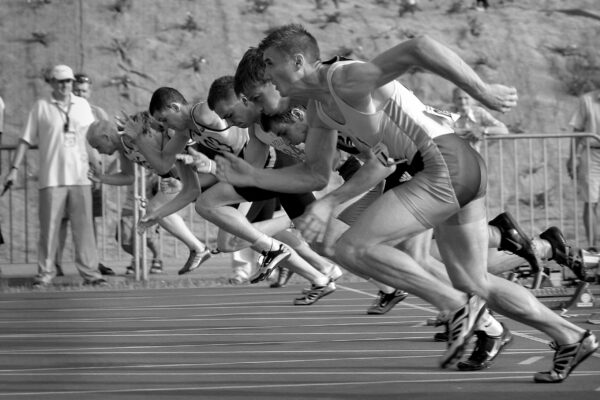
Basically, all runners improve their running economy through targeted training. You also become more familiar with your running style at the same time as the enzyme activity improves in relation to what you train, and you learn to move more efficiently. It just requires that you run long and long enough.
However, after a long period of traditional running training, many runners begin to have trouble improving their running economy. Unless you use other training methods. Some of the most effective methods to improve your running economy in these cases are in particular 4 strategies as below.
“The fastest runners are not always the fittest. Often, they are simply the most economical.”
👉 Small improvements applied consistently often lead to significant gains in running performance over time.
⚡Sprint Training

Superintense training sessions in max. Pace also called Sprint training can also improve the running economy. It can be, for example:
6 x 30 seconds with 3 min break
10 x 15 seconds with 3 min break
Run as fast as you possibly can. It is not a training session recommended for joggers as it is extremely hard and the risk of injuries is correspondingly greater.
💥Explosive Strength Training
Explosive strength training in a type of training such as jumping, bucket, hill jumping, stair training, stair jumping, etc. can both increase and maintain the running economy.
Training in competition tempo/technique training will also have an impact.
Technique training is often an overlooked training element among joggers. Most elite runners practice technique training a few times a week – often as part of the warm-up for interval training.
A relaxed technique not only increases the running economy but also the experience. Introduction to technique training requires a trainer who can teach the various coordination exercises. However, there are lots of movie clips on eg YouTube, where the exercises are shown.

🔥Intensive Training
This is typically interval training where the training must be varied and includes many different forms of training if you really want to see improvements. Many joggers run the same route at the same pace in all of their training sessions.
In this way, it is primarily Endurance that is stimulated and trained. And there is virtually nothing wrong with that. It’s just not optimal training if the purpose is to develop and become a better and faster runner.
There are many indications that many kilometers over many years have a positive impact on the running economy. But Of course, it’s difficult to change from one day to the next. But fortunately, there are several training types and workouts that you can perform right away that will improve your running economy in the short and long term.
👉 Higher-intensity sessions are one of the most effective ways to improve your lactate threshold.
🧪Exercise Economy
Exercise economy is another way to define or interpret running economy in practice. Exercise economy or also called movement economy refers to the amount of oxygen VO2 required to move at a given speed, power, or work rate. It is a very good predictor of endurance training and performance in many endurance sports such as running, cycling, etc. The runner’s performance thus depends on how well he is able to utilize the available oxygen.
Below we’ll look at how you can improve your running performance through factors you can influence…
👉 Endurance training plays a key role in improving how efficiently your body uses oxygen during exercise.
👟Long Distance Running Technique
The running technique greatly influences the running economy. As you know now – A good running economy is the ability to maintain high speed for a long time at a minimum of energy consumption. The running economy thus depends in part on a high anaerobic threshold (AT), as it is precisely this that determines the limit for when lactic acid production becomes too high, and we are forced to slow down the pace
However, AT is not the only factor that comes into play when we talk about running economy. Running economy just as well depends on a wide range of factors such as physique, leg length and weight, optimal stride length, mobility, and flexibility as well as muscle fiber type composition.

Many of these factors we are not even able to influence. They are genetically determined. The optimal stride length is still up for debate, and here no one has the “truth” yet.
Instead, you might want to take a look at your practical running technique if you want to get a little more out of your run. Many people tend to use small ultra-short steps and arms tightly wrapped to the body. This is not unusual, and probably closer to one of our most favorite running styles.
“Small improvements in running form can save energy for every mile you run.”
👉 Long runs provide an excellent opportunity to refine running technique under realistic endurance conditions.
👣Exercise economy short steps
When running, remember to lift both knees and feet. This is not up for discussion but does not always come naturally to some runners. Too short steps can slow down the running movement, as this risks putting the foot in the ground too early and in front of the body instead of pulling it under you and creating propulsion.
This slows down the momentum, and you have to use extra forces both on the extra steps and on pulling each step up from “the bottom” instead of just letting the momentum handle a large part of the propulsion completely “for free”.
Try if necessary. to lift your knees a little higher the next time you are out running -Not excessive, just a little -and see if you can feel a difference. The race should thus be a little easier, and more “floating”.
📏Exercise economy long steps
Conversely, too-long steps can also cause a loss of momentum, as the race may be a little more reminiscent of jumping from leg to leg, whereby the movement can be “bouncing” up and take place up and down instead of straight ahead. This will result in the runner’s head “jumping” up and down rather than following a straight line.
This type of running will be very energy-intensive, as the muscles of the legs have to use a lot of force to “grab” the body every time it lands. With long strides, you land heavier and the total energy consumption becomes greater; energy that should actually have been spent on propulsion. Therefore, it is about finding the line between too short and too long steps. You have to try it for yourself.
🧍Optimize your Posture
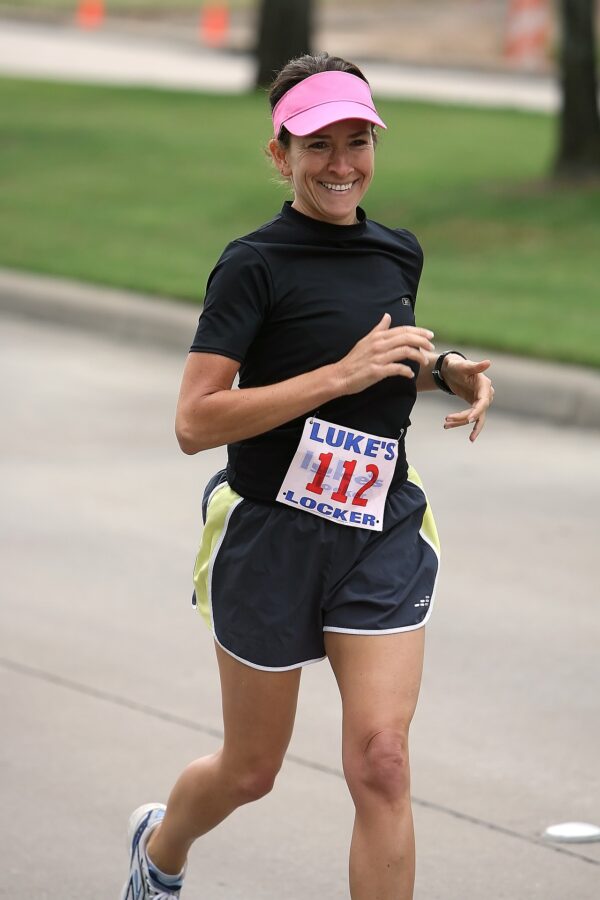
Try to run with an upright (and preferably slightly forward bent) posture. A weak core is often the reason why you collapse during the race. Every time we take a step, we send a certain amount of force into the ground.
This force is returned and absorbed by the body. You can compare the body to a spring! A tensioned spring, which is released from a height of e.g. 1 meter, will develop more force and thereby jump higher than a slack spring that releases from the same height.
The tensioned spring simply receives the reactive force better and utilizes it more efficiently. The same goes for the body! In order to increase the propulsion, the upper body may be tilted slightly forward, but not at the expense of it to collapsing.
“Good posture doesn’t create speed by itself—but it allows every stride to work more effectively.”
👉 Monitoring perceived effort can help you maintain efficient posture and technique as fatigue builds.
👀Position of The Head
Should preferably sit on top of the shoulders and not hang in front of them, cf. posture. Some runners tend to turn their head from side to side, which is not appropriate, as this movement will to a greater or lesser extent be copied to the rest of the body, which thereby comes in small “oscillations”, and the energy is not optimally utilized as previously mentioned, i.e., exclusively going forward.
💪The arms Movement
Whether you use one or the other step length, there are also the arms to take into account. The arms during running is probably one of the most underestimated factors. Two scenarios often apply among runners.
One is the tendency to run with the arms wrapped close to the body. The second is the arms, or often in fact only one arm, fluttering far out from the body in a rarely seen movement pattern. It can be set up quite simply: What the arms do, the legs copy to some extent. The arms must take care of this during the running training.
🧮Calculate Running Economy
It will be interesting to know how we can calculate running economy and after a period of time, calculate it again to see whether there is a progression or we can maybe compare our running economy with others!
Running economy is the amount of energy required to run at a given running speed and is expressed as oxygen uptake (VO2) at the given running speed.
To Measure, the exact running economy is complex and can be inaccurate, as the measurement is determined by various variables. However, an estimated measurement of the running economy can give an interesting insight into the individual performance, and it gives the opportunity to compare with other runners. A way to do it is by using an online calculator such as VDOT Running Calculator.
“What gets measured can be improved—but how you move will always matter more than any number.”
👉 Heart rate data can help runners track progress and better understand their training adaptations.
❓ Frequently Asked Questions
What is running economy?
Running economy describes how efficiently your body uses oxygen at a given running speed. Runners with better running economy use less energy and oxygen to maintain the same pace compared to less economical runners.
Why is running economy important for marathon runners?
A good running economy allows marathon runners to maintain their pace longer while conserving energy. This can improve endurance, delay fatigue, and contribute to better race performance.
Can running economy be improved?
Yes. Most runners can improve their running economy through consistent training, better running technique, strength work, sprint training, and structured interval sessions.
Does running technique affect running economy?
Absolutely. Factors such as posture, stride length, arm movement, and foot placement all influence how efficiently you move and how much energy you use while running.
How can I measure my running economy?
The most accurate measurements require laboratory testing of oxygen consumption. However, tools such as VDOT calculators, race performances, and heart rate data can provide useful estimates and help track progress over time.
🧠 Final Thoughts
Running economy is one of the most overlooked factors in distance running performance.
While fitness, endurance, and mental strength all play important roles, your ability to move efficiently can have a significant impact on how fast and how far you can run. Small improvements in technique, posture, strength, and training structure often add up to meaningful gains over time.
The good news is that running economy is not reserved for elite athletes. Recreational runners can improve it too through consistent practice and smart training choices.
Focus on becoming a more efficient runner, and you’ll often find that speed and endurance improve naturally as a result.
What changes have helped improve your running economy? Share your experiences in the comments below.
📢 Enjoyed This Article?




This is the first information I have ever read about “running economy.” Although I am only a jogger, I found your article very interesting. I am quite sure that the tips you have given on positioning the body for efficient running will help even for jogging. My shoulders and neck ache for a lot of the time when jogging. It might be the way I am holding myself. Thanks for the helpful article.
Hi Anastazja
Thank you for the comment. As a jogger, you have a great starting point for training your running economy.
Be Well
My brother in law is a marathon runner and was recently talking about running economy. He tried to explain to me what it was about, but I didn’t really understand it all. After reading this post I now have a far better understanding about running economy and how you can improve your running performance with good running economy.
I will be sharing your post with all the runners that I know.
Hi LineCowley
Thank you for the comment. Happy that you find the post useful for sharing.
Be Well