

Running places significant impact on your feet and legs, making the right running shoes an important part of a comfortable and sustainable running routine. With so many models available, choosing the right pair can feel difficult. In this practical running shoe guide, we look at how your feet, running style, running surface, and preferred distances can influence your choice. A professional running analysis can also help you understand which shoes suit your individual needs.
🏃 Why Running Analysis Is Important?
A running analysis can help identify movement patterns and imbalances that may affect the way your body works when you run. When some joints or muscles are not working efficiently, other muscles may have to compensate for them. Over many kilometers, this additional workload can contribute to discomfort or injuries and may affect your ability to train consistently.
A running analysis can therefore provide useful information about your running style and help determine what type of support you may need from your running shoes. Modern analysis equipment can measure running movements very precisely, offering insights that were much harder to obtain in the past.
You can have your running assessed using professional gait-analysis equipment, for example through a specialist running store. You can also make a simple assessment yourself by examining the wear pattern on an old pair of running shoes. Taking the shoes with you when you visit a running store can give the salesperson useful information about how you run.
Once you have a better understanding of your running style, you have a much better starting point for choosing running shoes that suit you.
👉 Understanding your running style can help you make better decisions about running shoes.
Understanding how you run can help you make better choices about the shoes you run in.
👟 The Best Running Shoes
When choosing running shoes, the most important question is not simply which shoe is rated as the best, but which shoe works best for your running style, your feet, and the way you intend to use it.
When comparing running shoes, consider these key characteristics:
- Cushioning and stability: How well does the shoe absorb impact? Is it stable on the surfaces where you normally run, and is it suitable for the type of running or racing you plan to do?
- Comfort and fit: Does the shoe sit comfortably on your foot? Is the size and width right? Are there seams or other details inside the shoe that cause discomfort? Consider how your feet feel during and after a run, as well as the overall weight and feel of the shoe.
- Special features: Some shoes offer characteristics such as a particularly low weight, additional shock absorption, extra width, or design features intended to provide a little more energy or speed. These features are more personal and depend on what you value in a running shoe.
👉 Choosing the right shoes starts with understanding your individual running needs.
The best running shoe is not the one with the most features, but the one that suits you.
🦶 Choose the Right Running Shoe
Choosing running shoes is a personal decision. There is no single shoe that is the best choice for everyone, because your feet, running style, and needs are different from those of other runners.
As a starting point, you can look at the position of your feet while standing:
- Low arch (flat feet): A shoe with moderate to strong support for overpronation may be appropriate.
- Normal arch: A neutral shoe or a shoe with light overpronation support may be suitable.
- High arch: A neutral running shoe is generally a good starting point.
- Legs that bow outward: If your knees point outward, you may have a neutral or supinating running pattern and should generally look towards a neutral shoe.
- Knees that point inward: If your knees move towards each other when standing, you may be more likely to roll inward and may benefit from a shoe offering light to stronger overpronation support.
These observations can give you a useful starting point, but your individual running style and comfort should always be considered when choosing your shoes.
Your feet are unique, so your running shoes should be chosen for your feet—not someone else’s.
📏 What You Need to Know About Running Shoe Size Selection
Finding the right running shoe size can be surprisingly difficult because different brands do not always use the same sizing systems or measurements. The size you normally wear in everyday shoes is therefore not necessarily the size you should choose for running.
Several factors can influence the right running shoe size:
- Foot arch: Your arch can change over time. A lower arch can make the foot longer, while changes in foot strength can affect its shape and length.
- Weight and activity level: Changes in body weight and activity can affect the shape and size of your feet. Significant weight gain, for example, can cause the arch to lower and the foot to become longer.
- Fit and security: A closer fit can keep your foot more securely positioned as you increase your pace, although you still need enough room for comfortable movement.
- Type of shoe: Racing and performance shoes often have a closer fit than everyday training shoes.
- Socks: You can fine-tune the fit by changing sock thickness. Thinner socks provide more space, while thicker socks make the fit tighter.
The most important point is to judge the fit of the actual running shoe rather than relying only on the number printed on the box.
👉 Finding the right shoe fit starts with understanding your running shoe size.
A good running shoe starts with the right fit, not simply the right number.
🏆 What Is the Best Running Shoe?
The best running shoe is ultimately the one that suits your individual feet and running needs. A useful general starting point is to choose a running shoe that is around half to one full size larger than your normal everyday shoes. However, sizing varies between brands, so this should only be a starting point.
Some brands use UK sizing, while others use US, EUR, or centimetre measurements. This can make comparing sizes between brands confusing. For example, you cannot assume that the same EUR size will fit you equally well in two different brands.
If you already have a running shoe that fits well, it can provide a useful reference when choosing your next pair. But even then, always check the new brand’s own sizing information.
Remember that feet are individual. Some runners have wide feet, while others have narrow feet, and the same shoe size can therefore feel very different depending on the shoe’s shape and fit.
👉 When comparing different models, remember that the best running shoe is the one that suits your individual needs.
The best running shoe is the one that feels right when you run.
📐 How to Find the Right Size for Running Shoes
Finding the right running shoe size can be especially challenging when buying online, particularly when you are choosing a different brand from the one you normally use. Different brands use different sizing systems, so having a reliable reference can make the process much easier.
There are generally two situations:
- You already have a pair of running shoes that fit you well.
- You do not have a pair of running shoes yet.
I Already Have a Pair of Running Shoes
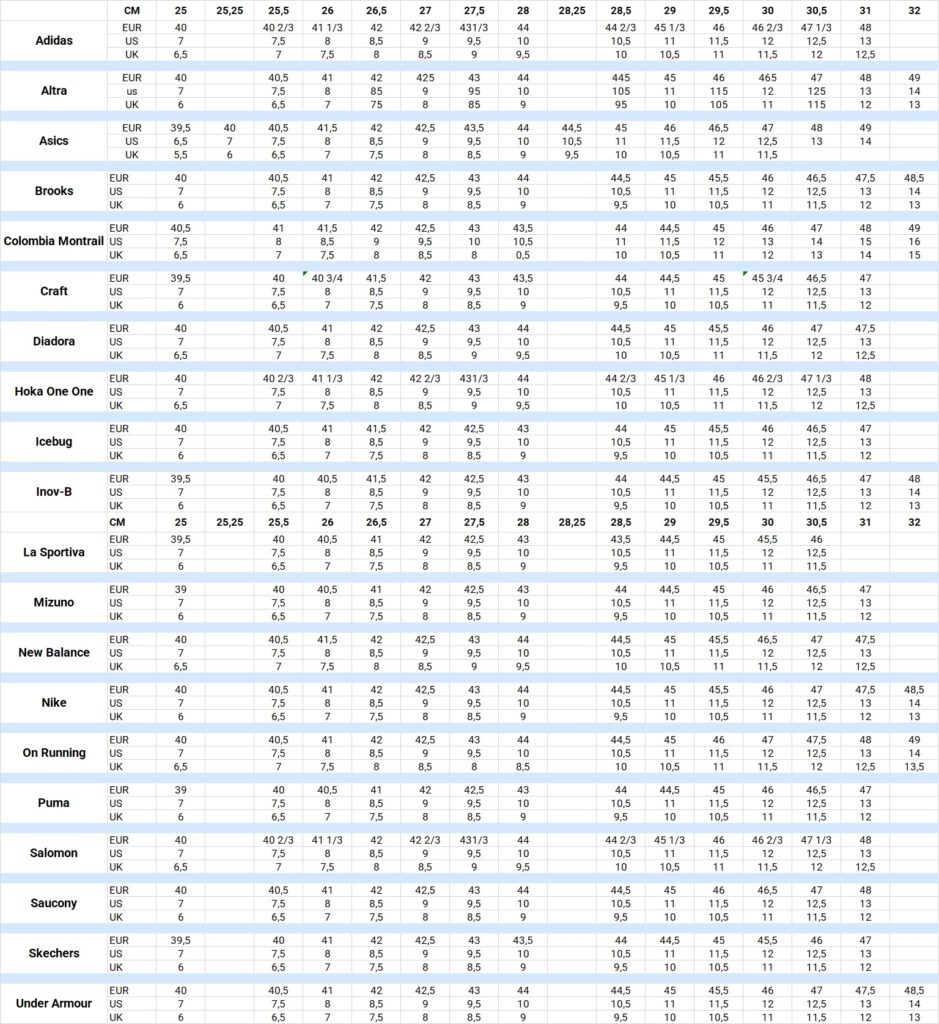
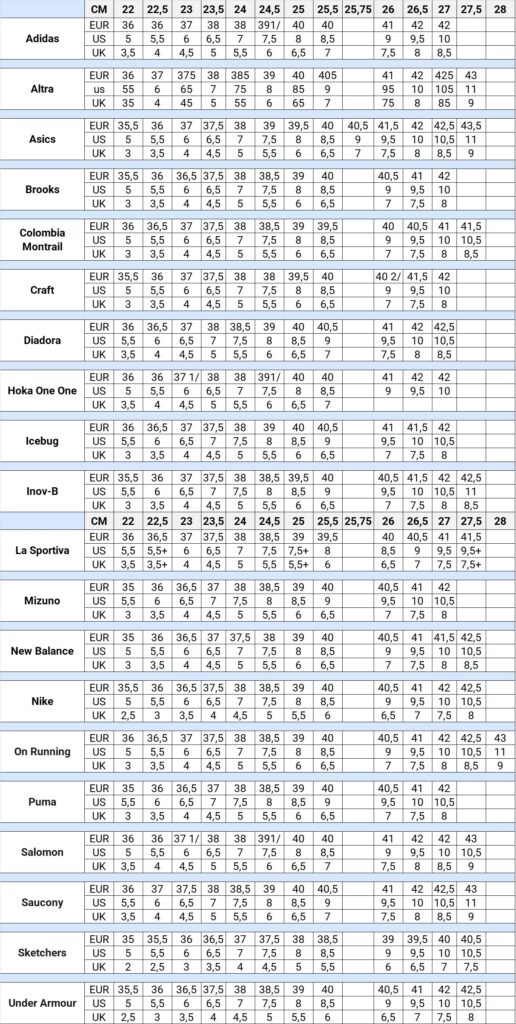
If your current running shoes fit you well, use them as your reference. Find your current brand and size in the running shoe size tables below, then move vertically through the table until you reach the brand of the new shoes you want to buy. The corresponding size gives you a useful starting point for your new pair.
If You Do Not Have a Pair of Running Shoes Already
The CM measurement indicates the inside length of the shoe in centimetres and is generally the most useful basis for comparing sizes between brands.
If you do not have an existing running shoe to use as a reference, measure the length of your foot and compare it with the CM measurement in the size table.
If you already own shoes but cannot find your brand in the tables, look inside the shoe for the number marked “CM” or “JP.” You can then use that measurement to find the corresponding size in the brand you want to buy.

📏 Running Shoe Size Guide
The size tables below use the CM measurement as the main reference. This indicates the inside length of the running shoe in centimetres and provides a useful basis when comparing sizes between different brands.
In most cases, the tables will give you the correct running shoe size. However, some shoes may fit slightly differently because of their construction. For example, a close-fitting upper can make a shoe feel smaller than the measurement suggests, in which case you may need to go up by around half a centimetre.
When choosing a new pair, use the tables as a guide rather than relying solely on the size you normally wear.
Table 1 Men
👩 The Best Running Shoes Women
Women’s running shoes are not simply different because of their colours or available sizes. One of the main differences is the fit. Women’s running shoes are generally narrower at the heel and wider towards the forefoot, which can provide more room around the toes.
This can be important because women may experience problems around the big toe and therefore benefit from additional space in the forefoot. Conversely, some men may find women’s running shoes too narrow, while women may feel that men’s shoes leave too much room around the foot.
Body weight can also influence how a shoe feels during running. Women are generally lighter than men, so running shoes designed for women may use cushioning characteristics that reflect this difference.
Ultimately, however, the most important factors are fit, comfort, and how the shoe feels when you run.
Fit and comfort matter more than whether a shoe is labelled for men or women.
Table 2 Women




Thank you for this article! Every 6 months I am tryin to find some shoes that fit and feel GOOD and every time, I end up chucking them into the bin before I can even get a good wear out of them.. I am definitely going to check to see if there is a shop here to help me identify my running style and get fitted properly before i start my running journey. Super informative article thank you!
Hi Rachel
Thank you for the comment. Finding your running style first is the best thing you can do for your running journey – wish you the best here
I learnt a hard lesson when it comes to selecting running shoes. I selected the wrong pair for my body type and it lead to painful legs overtime. Took a long time to recover and I had to visit a feet expert to solve my problems. The analysis you mentioned, how does it work? Is it in a store or can I get it on a app for my phone?
Hi Bernard
Thank you for the comment and your question.
A running gait Analysis is a professional health tool used to locate a cause of your pain / injuries in relation to running – in a clinic. At the same time, the analysis is a tool to improve and develop the committed runner. You can learn more here: https://bit.ly/3omWroI
Be Well
Thank you for sharing these points. I began running in March 2020, when the pandemic started. And after that, I have increased my training to swimming and doing a bit of gym. But my main goal is running.
I had not considered searching for a blueprint before buying our running shoes. But due to how important a good fit is, this suggestion is gold.
Is this table about the CM indication official? I mean, how did it come into existence? Did every brand give its measurements? Or is it created by a third party?