
Legend of Marathon story begins with a timeless tale of endurance, sacrifice, and extraordinary courage. It tells the story of Pheidippides, the messenger who ran from Marathon to Athens to announce a historic victory—a run that inspired the modern marathon. Blending history, myth, and human aspiration, the story continues to inspire runners, athletes, and history enthusiasts alike, demonstrating how a single act of determination can leave an enduring mark across centuries and cultures.

🏃♂️The Legend of Marathon Story – Pheidippides’ Enduring Tale
The first marathon ever told rooted in the legend of Pheidippides. It is a story where historical events and heroic imagination merge into something greater than facts alone. No one knows exactly how the legend took its final shape. Over centuries, it has been retold, reshaped, and reinterpreted.
Yet the essence has never changed.
The story speaks of human perseverance, of suffering endured for a greater cause, and of victory delivered at the ultimate personal cost. Whether Pheidippides truly ran his final steps from Marathon to Athens is still debated. But the meaning of the story has never depended solely on its factual accuracy.
Some stories endure because they express what we aspire to be.
In ancient Greece, messengers known as hemerodromoi ran long distances as part of their daily duty. Pheidippides would have trained for endurance over rocky paths, across hills and plains, carrying urgent messages from one city-state to another.
His body and mind were forged by these grueling runs, turning physical suffering into a skill essential for survival and communication in a world without roads or modern transport.
“Whether true or not, the story of Phei dippides reminds us how far purpose can carry the human body.”
👉 Many runners experience moments where purpose and movement merge into a state of complete focus and forward momentum.
⚔️The Legend of Marathon Story – The Battle of Marathon, 490 BC
The legend begins in 490 BC on the Attic plateau, northeast of the small Greek town of Marathon. Here, the forces of Athens and Plataea faced the mighty Persian Empire.
For the Greeks, this battle was not only about military survival. It was a struggle for a revolutionary idea: freedom. They fought against what they perceived as oppression, slavery, and the loss of political self-determination. In their own eyes, Marathon became a defining moment in the defense of free civic life.
Against all expectations, the smaller Greek force launched a bold and disciplined attack. The battle was fierce and violent, but by early morning the Persians were defeated. It was a victory that would echo far beyond the battlefield.
Yet one final task remained: Athens had to be told.
The battle was not only a military encounter but a defining moment for Greek political identity. Victory at Marathon became a symbol of freedom and civic courage, inspiring generations of city-states to value self-governance, strategic unity, and the defense of democratic ideals.
The psychological impact of this triumph echoed through Greece, amplifying the legend of those who ran to deliver the news of their success.
🏃♂️📏The Legend of Marathon Story – Pheidippides’ Run from Marathon to Athens
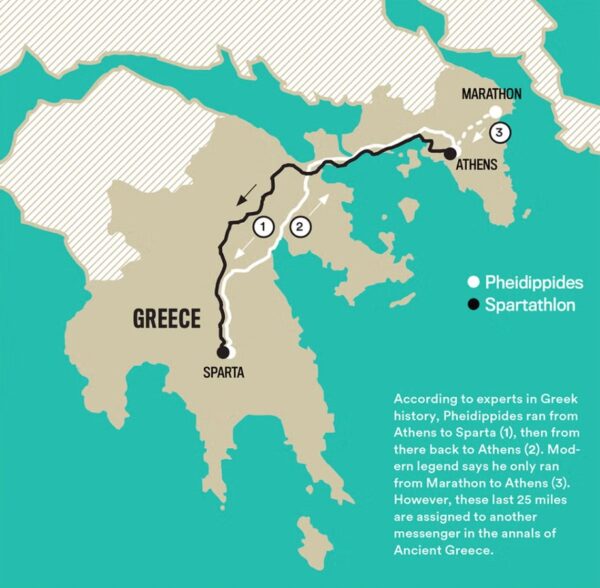
According to later accounts, Pheidippides—a trained long-distance messenger—was sent from the battlefield to Athens to announce the victory. The distance was roughly 40 kilometers across rugged terrain.
It was late summer. The heat pressed down on the scorched landscape, turning the run into an ordeal of dust, thirst, and exhaustion. Each step demanded resolve.
When Pheidippides finally reached Athens, he delivered his message:
“Rejoice, we have won.”
Moments later, he collapsed and died.
Whether this specific run occurred exactly as described is uncertain. Ancient sources differ, and some historians believe the story conflates multiple messenger journeys into a single dramatic climax. But uncertainty has never weakened the legend. On the contrary, it has strengthened its symbolic power.
The run was grueling in every sense. Dust swirled in the dry summer air, the sun scorched the rocky terrain, and the distant echoes of battle still lingered in the hills. Pheidippides’ muscles burned with every step, his lungs gasped for air, and his mind battled despair and determination simultaneously.
Yet, every heartbeat brought him closer to Athens, every step a testament to human resilience, courage, and the unyielding power of a mission that transcended personal safety.”
📜Myth, History, and Human Meaning of the Legend of Marathon Story
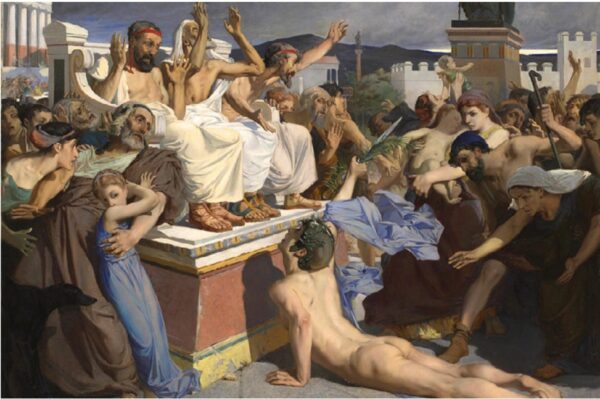
Herodotus describes Pheidippides running from Athens to Sparta before the battle—a journey of more than 240 kilometers—to request aid. Later writers introduced the Marathon-to-Athens run, and over time the stories fused into a single narrative.
This is how origin myths are formed.
They are not created to document facts, but to express values. The legend of Marathon celebrates endurance, loyalty, and sacrifice. It tells us what ancient Greece admired—and what modern runners still recognize in themselves.
“The marathon is not born from measurement, but from meaning.”
👉 Many runners discover that endurance running becomes a journey of self-discovery and personal growth far beyond physical fitness.
🏅The Legend of Marathon Story – Birth of the Modern Marathon
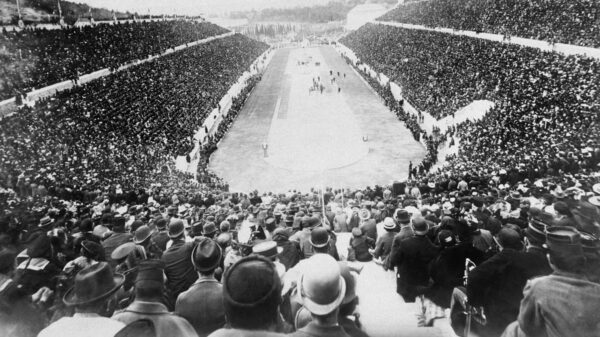
The legend might have remained an ancient curiosity if not for the revival of the Olympic Games in 1896. Seeking to honor classical Greece, the organizers introduced the marathon race as a tribute to Pheidippides.
The distance was approximately 40 kilometers, closely reflecting the legendary route. From the beginning, the marathon was seen as the ultimate endurance challenge—a test not just of speed, but of character.
In 1897, the first city marathon was established: the Boston Marathon, which remains one of the most prestigious races in the world today.
When the modern Olympics were revived in 1896, organizers looked to the legend of Pheidippides for inspiration. The idea of a road race connecting history and athleticism captured the imagination of athletes and spectators alike. The first marathon course, roughly mirroring the legendary route, was designed to honor both the story and the endurance it symbolized.
👉 Modern city marathons continue to inspire thousands of first-time runners to take on challenges they once thought impossible.
📐Why the Marathon Is 42.195 Kilometers – A Legend of Marathon Story Perspective
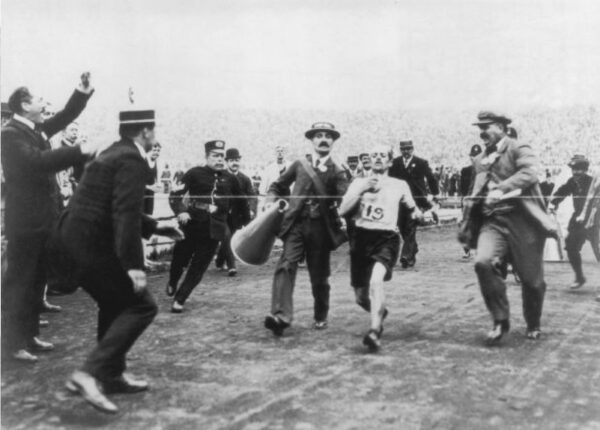
The official marathon distance was fixed at the 1908 Olympic Games in London. The reason was surprisingly human.
The British royal family wished to view the start of the race from Windsor Castle and the finish inside the Olympic Stadium. The added distance resulted in the now-standard 42.195 kilometers.
What began as a practical adjustment became tradition—proof that even legendary distances can be shaped by circumstance.
🌍From Elite Test to Human Possibility – The Legend of Marathon Story Today

For decades, the marathon remained an event for a small, elite group of athletes. It was considered extreme, almost unreachable for ordinary people. Much of the race unfolded on open roads with little attention, and only the final meters were visible inside the stadium.
Everything changed in 1972.
At the Munich Olympic Games, American runner Frank Shorter entered the stadium for the final 400 meters—and the world saw something new. He was not broken. He was not grimacing. He looked calm, controlled, almost effortless.
As the commentator shouted, “Come on, Frank, you’ve won it!”, millions realized that the marathon could be something else.
“Frank Shorter didn’t just win a race—he changed how the world saw endurance.”
Shorter’s victory ignited the modern running boom, much as Pheidippides’ legendary run ignited the original myth.
👉 For many new runners, the marathon journey becomes more enjoyable when training is combined with community and shared experiences.
🕊️Living Legacy of the Legend of Marathon Story

Today, the marathon is no longer unattainable. Millions of runners—elite and amateur alike—stand at starting lines around the world. They run for health, for healing, for memory, for meaning.
Yet beneath GPS watches, training plans, and modern shoes, the ancient story remains.
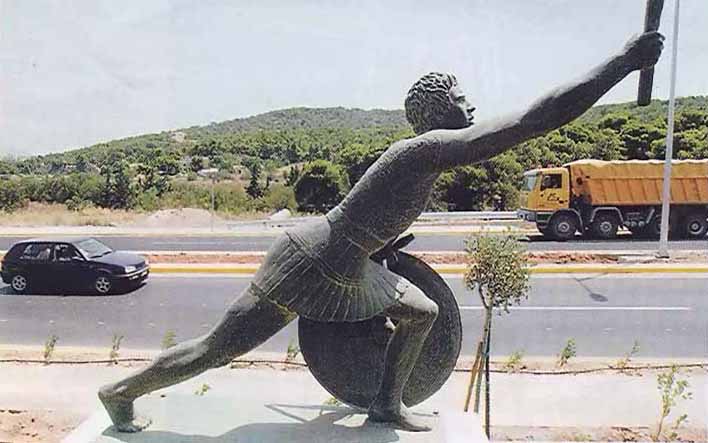
Along the original Olympic marathon route near Rafina, Greece, stands a statue of Pheidippides. It is a quiet reminder that the marathon is more than a race.
It is a story—one that lives every time someone runs farther than they believed possible.
Today, millions of runners around the world trace paths inspired by Pheidippides’ run, from urban marathons to charity events. The story has transcended history to become a global symbol of perseverance, pushing ordinary people to achieve extraordinary feats. Each step taken by modern runners echoes a timeless legend that celebrates courage, endurance, and the human spirit.
❓ Frequently Asked Questions
What is the legend of Marathon?
The legend of Marathon tells the story of Pheidippides, the ancient Greek messenger who is said to have run from Marathon to Athens to announce the Greek victory over Persia in 490 BC.
Did Pheidippides really run the first marathon?
Historians disagree. Ancient sources describe different messenger journeys, and some believe later writers combined several events into one legendary story. Regardless of historical accuracy, the legend inspired the modern marathon.
Why is the marathon connected to ancient Greece?
The modern marathon was created for the 1896 Olympic Games in Athens to honor the story of Pheidippides and the Battle of Marathon, linking the event to Greece’s historical and cultural heritage.
Why is a marathon 42.195 kilometers long?
The official distance was established during the 1908 Olympic Games in London when the course was extended to accommodate the British royal family. The distance later became the international standard.
Why does the story of Pheidippides still inspire runners today?
The legend represents courage, perseverance, sacrifice, and determination. Many runners see the story as a reminder that endurance is about more than physical strength—it is also about purpose and resilience.
💭Final Reflection on the Legend of Marathon Story
The legend of Marathon endures because it reflects something universal. It reminds us that endurance is not only physical. It is emotional. Moral. Human.
Whether Pheidippides truly ran his final steps does not matter as much as this:
His story still moves us forward.
If this story moved you, consider sharing it—so the legend of Marathon can continue its journey.
Updated for 2026: This article has been reviewed and updated to improve historical context, readability, and relevance for today’s marathon runners while preserving the original story and inspiration behind the legend of Marathon.