
Personal Growth Through Outdoor Running: Transform Your Mind is about far more than improving fitness or burning calories. When you run outside—especially in nature—you create space for reflection, emotional clarity, and mental resilience. Over time, outdoor running can become more than exercise; it can become a tool for self-discovery and personal development. In this post, you’ll learn how running in nature, racing, and year-round training can shape both your mindset and your life.

👉 Running also offers powerful mental health benefits beyond personal growth and reflection—especially when training, it becomes a consistent part of your lifestyle.
Outdoor running trains more than your body—it shapes your perspective.
🌲 Running in the Forest – The Honest Hour
Over time, these quiet runs begin to build a deeper relationship with yourself. You start noticing patterns in your thinking. Some thoughts appear again and again—worries, ambitions, questions about life direction. Running in nature creates space where those thoughts can move freely without pressure.
Many runners experience that solutions appear naturally during long runs. Not because they actively search for answers, but because the mind finally has room to breathe. The forest becomes a moving meditation.
Psychologists sometimes refer to this as “attention restoration.” When the brain is exposed to natural environments, mental fatigue decreases, and creative thinking increases. Running amplifies that effect because movement stimulates circulation and oxygen flow to the brain.
👉 Studies suggest that spending time exercising in nature may improve mood and cognitive function compared to indoor environments. Read more.
But beyond the science, there is something deeply human about being alone on a trail with nothing but your breath and your footsteps for company. In a world full of constant noise, notifications, and obligations, the forest offers rare silence. That silence can feel uncomfortable at first—but eventually, it becomes restorative. You stop reacting to the world and begin listening to yourself.
The result is often simple but powerful: you return home calmer, clearer, and slightly wiser than when you left. Not because the run changed your life in one hour—but because repeated moments of stillness slowly change the way you think, feel, and respond to everyday challenges.
Sometimes the clearest thoughts arrive when the world finally goes quiet.
🔥 Running Motivation – Experiencing Success Differently
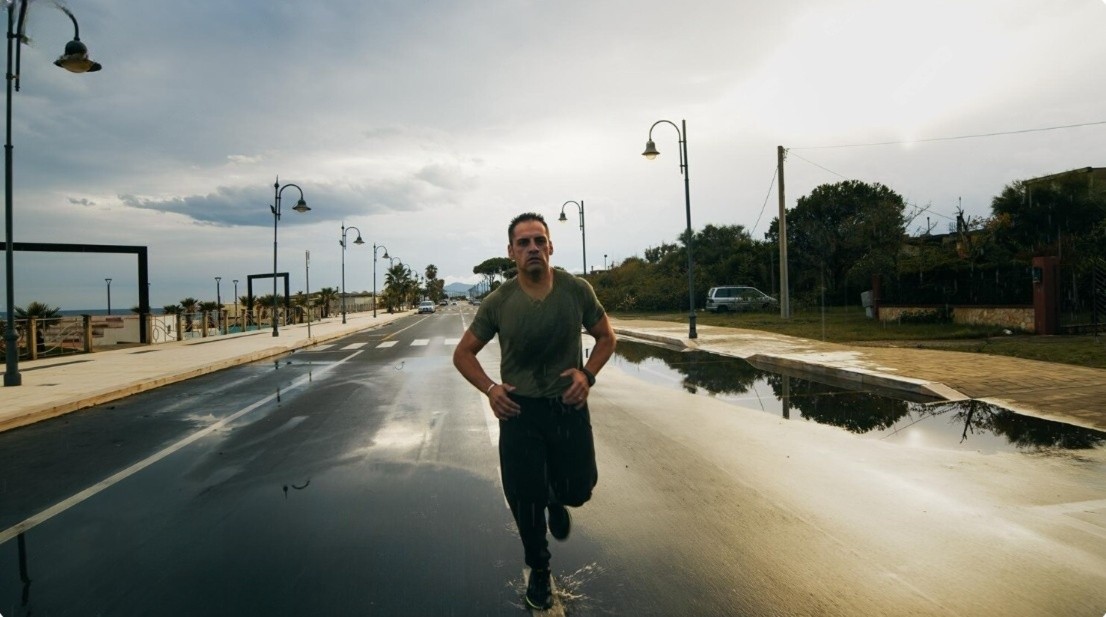
These small victories accumulate over time.
A run in bad weather.
A run after a stressful workday.
A run when motivation felt completely absent.
Each time you complete such a run, your identity as a runner strengthens. Confidence rarely appears suddenly. It grows quietly through repeated proof that you can do difficult things. Running provides that proof again and again.
Many runners eventually realize that motivation is not something you wait for. Motivation is something you create through action. The first kilometers may feel heavy, but once the body warms up, something shifts. Discipline slowly transforms into freedom.
You no longer run because you have to—you run because it has become part of who you are.
What starts as effort eventually becomes identity. You begin trusting yourself more, not just in training but in other areas of life as well. The discipline required to lace up your shoes on difficult days teaches you that progress rarely depends on perfect circumstances. It depends on showing up consistently, even when conditions are not ideal.
That lesson carries far beyond running. The resilience built during hard training days often influences your work ethic, your confidence, and your willingness to face discomfort elsewhere in life. Running teaches you that growth rarely happens inside comfort zones—and that realization can quietly reshape the way you approach challenges altogether.
Confidence grows when you repeatedly prove to yourself that you can keep going.
🧘 Being Present After the Run

As a former competition runner, I once felt it was wrong not to train. Rest days felt lazy, and every run had to serve a measurable purpose. Today, the experience matters more than the stopwatch.
I often drive to new locations, explore unfamiliar forest routes, and track them on my sports watch to stay oriented—not to optimize performance, but to discover. Something is refreshing about running without needing the route to be efficient, strategic, or repeatable. Sometimes the value lies simply in seeing somewhere new.
After finishing, I sometimes sit quietly in my car for several minutes. No music. No phone. Just stillness.
Running clears the mind in a way desk work never can. Some of my best writing ideas appear during or immediately after a run. Sentences form naturally. Problems untangle. Thoughts that felt heavy before the run often seem manageable afterward.
When the body moves, the mind opens.
That post-run stillness has become part of the ritual itself. The run may end when the watch stops, but the mental clarity often continues long afterward. Many runners know this feeling—the strange sense that the world slows down for a while, and everything becomes easier to process. In that sense, running is not merely an exercise. It is preparation for the rest of the day.
👉 For many runners, this is part of why running can feel therapeutic over time.
When the body moves, the mind often finds room to breathe.
🏁 Experience Public Races – The Need to Be Seen

Running alone is powerful. But the opposite experience can be just as meaningful.
Participating in a public race—maybe even a marathon—allows you to share your effort with others. And yes, you can prepare for that challenge from your current level.
There is nothing wrong with wanting to be seen.
Encouragement, applause, and recognition are not childish needs. They are human needs. Whether from spectators, friends, family, or fellow runners, support strengthens identity.
Training builds character in solitude. Races celebrate it in public.
Both are valuable.
For many runners, race day becomes more than a competition. It becomes proof of commitment. A visible expression of all the quiet miles nobody else saw. The early mornings, the tired legs, the sessions completed in bad weather—all of it suddenly becomes real when you step onto a start line.
Public races also create connections. Even if you run alone physically, you are surrounded by people who understand the journey. For one day, your private discipline becomes part of something bigger. That shared energy can be deeply motivating and emotionally powerful, especially for runners who spend most of their training in solitude.
Training builds discipline in private—races let you celebrate it in public.
🌦️ Running Training All Year

Seasonal running also teaches resilience.
A cold winter run often feels intimidating before you start. But once you are moving, the body adapts quickly. Breathing becomes steady, muscles warm up, and the fresh air creates an energizing contrast to indoor life.
Many experienced runners say that winter runs are among the most memorable ones. Not because they are easy—but because they feel authentic.
Rain, wind, or snow remind us that running is not dependent on perfect conditions. Instead, it becomes a dialogue between the runner and the environment.
And that dialogue builds mental strength that carries over into other parts of life.
When you learn to run despite discomfort, you gradually stop needing ideal circumstances in order to act. You realize that motivation is less important than preparation, and that progress often belongs to those willing to continue when conditions are less than perfect.
There is also a quiet pride in finishing a run that almost did not happen. The kind of session where you nearly stayed home, but went anyway. Those runs rarely produce personal records—but they often produce personal growth. They remind you that…
Resilience is built on the days you run when conditions are far from perfect.
👣 Running All Life

Another remarkable aspect of lifelong running is the sense of continuity it provides.
Years may pass. Jobs change. Children grow up. Life circumstances shift. But the simple act of putting on running shoes and stepping outside remains the same.
Many long-term runners describe this as a form of personal anchor—something stable in an otherwise changing world.
Running does not demand perfection. Some years you train more. Other years less. The important thing is that the relationship with movement continues.
Over decades, that relationship becomes less about performance and more about appreciation. You run not to prove something—but because it enriches life.
There is comfort in returning to something familiar through every season of adulthood. In times of stress, running provides release. In times of uncertainty, it provides routine. In times of happiness, it becomes celebration. Few habits remain relevant across so many phases of life in the same way.
That is part of what makes running unique. It evolves with you. The reasons you run at twenty may not be the reasons you run at forty or sixty, but the value remains. Over time, many runners discover that their relationship with running becomes less transactional and more personal. It is no longer about what running gives you—it is about what life feels like when running remains part of it.
Running evolves with you—its meaning changes, but its value remains.
🧾 FAQ: Personal Growth Through Outdoor Running
Is Running Outside Good for Mental Health?
Yes—running outdoors can significantly improve mental well-being. Natural environments help reduce stress, lower anxiety, and create a greater sense of calm compared to indoor exercise. Many runners find that combining movement with fresh air and natural surroundings improves mood and provides mental clarity that lasts long after the run is over.
Does Running Rewire Your Brain?
Regular running may support positive brain changes over time. Research suggests exercise helps strengthen neural connections, improve cognitive function, and enhance the brain’s ability to adapt to stress. In simple terms, consistent running can help train both your body and your mind to become more resilient.
What Does Running Do for You Mentally?
Running can improve mental health in several ways. It reduces stress, boosts mood, sharpens focus, and increases emotional resilience. Many runners also use running as a form of active meditation—an opportunity to process thoughts, solve problems, and disconnect from daily pressure.
Are Runners Happier People?
Many studies and runner surveys suggest they often are. Regular running is associated with improved mood, higher self-confidence, reduced tension, and greater emotional well-being. While running is not a cure-all, many people report feeling happier and more balanced when it becomes part of their routine.
💬 Final Reflection – Do You Want to Grow Through Running?

Running can be:
A quiet forest meditation
A personal growth laboratory
A creative thinking tool
A public celebration
A lifelong companion
It is simple. But not shallow.
👉 The broader benefits of running often extend far beyond physical fitness alone.
If you are interested in running experiences that help you grow—not only physically, but mentally and emotionally—you are not alone.
Running has a unique ability to shape us gradually. Not through dramatic transformation overnight, but through repeated moments of discomfort, discipline, reflection, and quiet satisfaction. The lessons often arrive subtly—through long miles, difficult weather, peaceful trails, and races that challenge your courage.
And you don’t have to be fast to begin. You don’t need perfect gear, elite fitness, or years of experience. You just need the willingness to take the first step and stay open to what the process may teach you.
Because sometimes, what begins as a way to improve your fitness becomes a way to better understand yourself.
If this resonates with you, feel free to share your own experience below.
How has running changed you?
What begins as fitness often becomes a deeper journey of self-discovery.
If you found this post helpful, feel free to share it with another runner who might need the reminder that running can transform more than just the body.