

Flow in running training is the experience of becoming fully absorbed in your run, where movement feels effortless and distractions fade away. In this guide, you’ll learn what flow is, why it matters, and how goals, motivation, feedback, and the right environment can help you experience it more often during training.
🌊 What Is Flow in Running?
Flow is one of the most rewarding experiences a runner can have. It is that rare feeling when everything seems to click into place. Your breathing feels natural, your stride feels effortless, and time appears to pass without you noticing.
Many runners describe flow as being completely absorbed in the run itself. You are no longer thinking about pace, distance, work, or everyday concerns. Instead, your attention is fully focused on the present moment and the simple act of moving forward.
Psychologist Mihaly Csikszentmihalyi introduced the concept of flow to describe this state of complete immersion and enjoyment. While flow can occur in many activities, running provides a unique opportunity to experience it because of its rhythm, simplicity, and connection between body and mind.
For many runners, flow becomes one of the hidden reasons they keep coming back. It is not about medals, race times, or external rewards. It is about experiencing moments where running feels natural, meaningful, and deeply enjoyable.

“The best runs are often the ones where time seems to disappear.”
🧠 Why Flow Makes Running Feel Effortless
Have you ever finished a run and wondered where the time went? That feeling is often a sign that you have entered a flow state.
During flow, your attention becomes fully absorbed in the activity. Instead of constantly evaluating your performance, your mind and body work together naturally. Running feels smoother, distractions fade into the background, and you become focused on the experience itself rather than the outcome.
Many runners report feeling calm, energized, and deeply satisfied after experiencing flow. Research has also linked flow states to improved learning, motivation, and performance. This may help explain why some runs feel surprisingly enjoyable, even when they are physically demanding.
Flow does not mean the run becomes easy. In fact, flow often occurs when you are challenged at just the right level. The effort is still there, but it feels manageable and engaging rather than overwhelming.
For this reason, flow is often described as one of the most rewarding aspects of running. It transforms training from something you have to do into something you genuinely want to do.
⚖️ The Balance Between Challenge and Skill
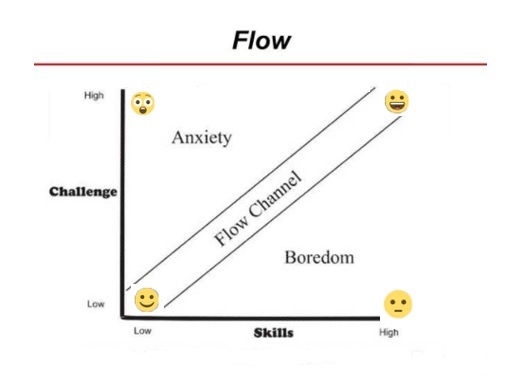
According to Mihaly Csikszentmihalyi, flow occurs when there is a balance between the challenge you face and the skills you currently possess.
If a run feels far too easy, boredom often follows. Your mind starts to wander, and it becomes difficult to stay engaged in the experience. On the other hand, if the challenge is too great, you may feel anxious, frustrated, or overwhelmed. In both cases, flow becomes difficult to achieve.
The sweet spot lies somewhere in the middle. When a run pushes you slightly beyond your comfort zone—but still feels achievable—you are more likely to become fully immersed in the activity. Your focus sharpens, distractions fade away, and running becomes more enjoyable.
This balance is not fixed. It changes as your fitness, confidence, and experience develop. A pace that once felt challenging may eventually become comfortable, requiring you to gradually raise the level of difficulty to stay engaged.
Understanding this relationship between challenge and skill is one of the most powerful tools for creating flow experiences in running. Rather than constantly chasing harder workouts, the goal is to find a level that keeps you both challenged and confident at the same time.
🚀 The Most Powerful Flow Triggers for Runners
Flow rarely happens by accident. While no runner can force a flow experience to occur, certain conditions make it much more likely.
Psychologists often refer to these conditions as flow triggers—factors that help create the focus, engagement, and enjoyment associated with flow. In running, these triggers can include clear goals, meaningful challenges, immediate feedback, strong internal motivation, and freedom from unnecessary distractions.
The more of these elements you can bring into your training, the greater the chance of becoming fully absorbed in the run. Flow is not about controlling every detail. Instead, it is about creating an environment where concentration, enjoyment, and performance can naturally come together.
The following flow triggers are some of the most important factors that can help runners experience this unique mental state more often.
⚖️ Balancing Challenge and Ability
One of the most important flow triggers is finding the right balance between challenge and ability.
If a run feels too easy, your attention often drifts elsewhere. You may start thinking about work, daily responsibilities, or what you are having for dinner. On the other hand, if the workout feels far beyond your current fitness level, frustration and anxiety can quickly replace enjoyment.
Flow tends to occur when the challenge is demanding enough to hold your attention, but still realistic enough that you believe you can succeed. You are fully engaged in the effort without feeling overwhelmed by it.
This is one reason why runners at every level can experience flow. A beginner may find flow during a comfortable 5K run, while an experienced marathon runner may find it during a challenging long run or tempo session. The key is not the distance or pace itself, but whether the challenge matches your current abilities.
When challenge and ability are in balance, running becomes more immersive, enjoyable, and rewarding. This is often referred to as the “flow zone”—the place where progress, focus, and enjoyment naturally come together.

🎯 Adjusting Challenges to Your Current Level
Finding the right balance between challenge and ability requires regular adjustment. As your fitness improves, your training should evolve with it.
Many runners make the mistake of increasing intensity too quickly. They compare themselves to faster runners, join workouts that are beyond their current level, or feel pressure to keep up with others. While this may seem motivating at first, it often creates frustration rather than flow.
A better approach is to gradually increase the challenge as your confidence and fitness grow. The goal is not to impress anyone else. The goal is to create positive running experiences that encourage you to keep coming back.
Running clubs can be helpful because they often group runners by ability, making it easier to find a level that feels both challenging and achievable. The same principle applies if you train alone. Start where you are today, build consistency, and allow your abilities to develop naturally over time.
When the challenge matches your current level, you are far more likely to stay engaged, enjoy the process, and experience the flow state that makes running feel so rewarding.
“Flow happens when challenge and ability meet.”
🏃 Why Freedom and Choice Improve Flow
Flow is easier to experience when you feel in control of your running rather than feeling controlled by it.
While training plans, coaches, and running groups can be incredibly valuable, most runners still need a sense of ownership over their training. Having the freedom to adjust a workout, take an extra recovery day, or change a route can make running feel more enjoyable and less like an obligation.
This sense of choice is important because flow thrives when you are actively engaged in what you are doing. If every run feels forced or disconnected from your personal needs and goals, it becomes harder to fully immerse yourself in the experience.
For some runners, this means training independently. For others, it means following a structured plan while still allowing room for flexibility. There is no single approach that works for everyone.
The key is finding a balance between guidance and freedom. When your training feels like a choice rather than a duty, motivation tends to increase, stress decreases, and the conditions for flow become much stronger.
“Running feels different when it becomes a choice rather than an obligation.”
🎯 Clear Goals Help Create Flow

Many runners associate goals with race times, finish lines, and personal records. While these goals can be motivating, they can also support flow when approached in the right way.
One of the most powerful flow triggers is having a clear and meaningful objective. When you know what you are trying to achieve during a run, it becomes easier to stay focused and engaged in the present moment. Your attention naturally shifts toward the task instead of wandering to unrelated thoughts.
The best goals are often both specific and energizing. They give you direction while also creating excitement about the journey ahead. For example, training for your first half marathon, completing a long run with confidence, or improving your endurance over time can all provide a sense of purpose that supports flow.
Goals do not have to be ambitious to be effective. In fact, smaller goals often work better because they feel achievable and allow you to experience regular progress. Each small success reinforces motivation and makes it easier to stay fully involved in the process.
When your goals are clear, meaningful, and aligned with your current ability, they create a strong foundation for both enjoyment and flow in running.
👉 Many runners find that setting meaningful goals helps maintain focus and motivation throughout months of marathon training.
📈 Feedback Strengthens the Flow Experience

Feedback plays an important role in creating flow because it helps you stay connected to your progress. When you receive clear signals that you are moving in the right direction, it becomes easier to stay focused, motivated, and engaged in your training.
Feedback can come in many forms. It may be a faster finish time on a familiar route, a lower heart rate at the same pace, or simply the feeling that a workout feels easier than it did a few weeks ago. These small signs of improvement reinforce the connection between effort and progress.
Technology can provide useful feedback through running watches, training apps, and performance data. However, feedback does not always have to come from numbers. Sometimes the most valuable feedback is noticing that you feel stronger, more confident, or more comfortable during your runs.
The purpose of feedback is not to judge yourself. It is to help you understand where you are today and recognize the progress you are making over time. When you can clearly see improvement, it becomes easier to stay immersed in the process and enjoy the journey rather than focusing only on the end result.
🏃 Using Test Runs to Measure Progress
One simple way to stay motivated and engaged in your training is to repeat the same route at regular intervals and compare the results over time.
A test run does not have to be complicated. It can be a familiar 5K route, a local park loop, or any course that reflects your current fitness level. By running the same route every few weeks, you create a simple benchmark that helps you track progress.
The value of a test run is not just the finish time. You may notice that your pace has improved, your heart rate is lower, or that the effort feels easier than before. These small improvements provide valuable feedback and reinforce the feeling that your training is moving in the right direction.
Even when the results are not what you hoped for, a test run can still be useful. A slower time may reveal the need for more recovery, better sleep, or adjustments to your training plan. Rather than viewing it as failure, it can be seen as information that helps guide your next steps.
Over time, these small checkpoints can strengthen both confidence and motivation, making it easier to stay committed to the process and enjoy the journey.
🤝 Running Clubs and Training Partners
While technology can provide valuable feedback, other runners can often offer insights that no watch or training app can measure.
Running with a club, coach, or training partner creates opportunities for encouragement, accountability, and honest feedback. Other runners may notice improvements in your form, consistency, or confidence long before you recognize them yourself.
Training with others can also make running feel more engaging and enjoyable. Conversations flow naturally, difficult workouts become easier to manage, and shared experiences create a sense of connection that many runners find highly motivating.
For some runners, group training can even create a form of collective flow. The rhythm of the group, the shared effort, and the common goal can make time pass quickly and help everyone become more immersed in the experience.
Whether you prefer running with a club, a friend, or a small training group, the support and feedback from others can strengthen both motivation and the conditions needed for flow.
👉 Recognizing progress is one of the most effective ways to maintain long-term motivation during marathon training.
🚫 What Prevents Flow During Running?
Flow requires focus. When your attention is constantly pulled in different directions, it becomes much harder to fully immerse yourself in the running experience.
Modern life is filled with distractions. Notifications, emails, social media, work-related stress, and everyday responsibilities can all compete for your attention before, during, and after a run. When your mind is scattered, it becomes difficult to settle into the rhythm that often leads to flow.
External distractions are not the only challenge. Internal distractions such as self-doubt, frustration, unrealistic expectations, or constantly judging your performance can be equally disruptive. Instead of being present in the run, you become trapped in your thoughts.
One of the simplest ways to improve your chances of experiencing flow is to create an environment that supports concentration. Choose routes you enjoy, minimize unnecessary interruptions, and allow yourself time to focus fully on the run itself.
Flow does not require perfect conditions, but it does require enough mental space for your attention to settle on the task at hand. The fewer distractions competing for your focus, the easier it becomes to experience the enjoyment, presence, and immersion that define flow.
🏃 How to Increase Your Chances of Experiencing Flow
While flow cannot be forced, there are several practical steps you can take to create the conditions that make it more likely to occur.
Many runners assume that flow is something that either happens or doesn’t happen. In reality, certain habits, training choices, and mindsets can significantly increase your chances of experiencing it. Small adjustments to how you approach your running can help you become more present, engaged, and immersed in the activity itself.
The following strategies are simple but effective ways to make flow a more regular part of your running experience.

😊 Follow What You Enjoy
One of the simplest ways to experience flow more often is to focus on the parts of running that you genuinely enjoy.
Many runners spend too much time trying to force themselves into training methods they dislike because they believe they are the “best” option. While certain workouts may be effective, they are unlikely to create flow if you dread every minute of them.
For some runners, flow appears during long, steady runs through nature. Others find it during social group runs, trail running adventures, or challenging interval sessions. The activity itself matters less than your personal connection to it.
When you enjoy what you are doing, it becomes easier to stay present, engaged, and immersed in the experience. Time passes more quickly, distractions fade into the background, and running feels less like an obligation and more like something you genuinely want to do.
If your goal is to experience more flow, start by identifying the types of runs you look forward to the most and make them a regular part of your training.
👉 Many runners discover that enjoyment is closely connected to the benefits of running and the positive changes it creates over time.
⚖️ Match Challenges with Confidence
A key part of experiencing flow is finding challenges that stretch your abilities without overwhelming them.
If your training feels too easy, you may become bored and lose focus. If it feels far beyond your current fitness level, frustration and self-doubt can quickly take over. Neither situation creates the ideal conditions for flow.
The goal is to find a challenge that feels meaningful but achievable. This is where confidence plays an important role. Confidence does not mean believing every run will be perfect. It means trusting that you have the skills, preparation, and determination needed to meet the challenge in front of you.
As your fitness improves, your confidence often grows alongside it. Small successes accumulate over time, making it easier to tackle longer distances, harder workouts, or more ambitious goals. This gradual progression helps maintain the balance between challenge and ability that lies at the heart of the flow experience.
When you consistently match challenges with your current level of confidence, running becomes more engaging, rewarding, and enjoyable.
👉 Building confidence through gradual progress is one of the most effective ways to prepare for long-term running success.
🚀 Growth Happens Outside Your Comfort Zone

Growth rarely happens when we stay within our comfort zone all the time. While flow requires a balance between challenge and ability, it also depends on our willingness to explore new possibilities and gradually expand our limits.
Many runners discover that some of their most memorable experiences occur when they attempt something that initially felt slightly beyond their reach. It could be running a longer distance, joining a race for the first time, tackling a hill workout, or simply maintaining a pace they once thought impossible.
The key is gradual progression. Flow is not created by throwing yourself into overwhelming challenges. Instead, it emerges when you take manageable steps forward and allow your skills to grow alongside the demands you place on yourself.
Every time you successfully meet a new challenge, your confidence increases and your comfort zone expands. What once felt difficult becomes familiar, creating space for new goals and new opportunities to experience flow.
By embracing growth while respecting your current abilities, you create the ideal environment for both personal development and the deep sense of engagement that makes running so rewarding.
✨ My Personal Experience with Flow Running
For me, flow has rarely appeared when I actively tried to force it. Instead, it has shown up unexpectedly during long runs where I felt completely absorbed in the experience.
Some of my strongest flow experiences have happened during marathon preparation. After settling into a comfortable rhythm, the usual thoughts and distractions gradually faded away. I stopped thinking about pace, distance, or how much running was left. My attention narrowed to the road ahead, my breathing, and the steady rhythm of each stride.
What surprised me most was how quickly time seemed to pass. Runs that might normally feel long suddenly felt shorter, and difficult sections became easier to handle because my focus was entirely on the present moment rather than the finish line.
I have also noticed that flow is more likely to occur when I am relaxed and not constantly evaluating my performance. The harder I try to force a particular outcome, the less likely flow becomes. When I trust the process, stay present, and simply enjoy the run, flow often appears naturally.
These experiences have taught me that flow is not something reserved for elite athletes. Any runner can experience it. The challenge is not finding flow itself, but creating the conditions that allow it to emerge.

👉 Many runners discover that the mental benefits of running become just as important as the physical benefits over time.
🌿 Why Nature Makes Flow Easier
Many runners find that nature provides some of the best conditions for experiencing flow. Away from traffic, noise, and everyday distractions, it becomes easier to focus on the run itself and settle into a natural rhythm.
For me, some of the most memorable flow experiences have happened on quiet trails, forest paths, and rural roads. The combination of movement, fresh air, and changing scenery creates an environment where concentration feels effortless. Instead of constantly reacting to external interruptions, my attention naturally stays on the present moment.
Nature also encourages a different mindset. There is often less pressure to monitor pace, compare performances, or chase numbers. The experience becomes more about the journey than the result. This shift in focus can make it easier to relax and become fully immersed in the run.
Research has shown that spending time in natural environments can help reduce stress and improve mental well-being. When combined with running, these benefits may further support the conditions that make flow possible.
Whether you prefer forest trails, coastal paths, parks, or quiet country roads, running in nature can be a powerful way to disconnect from daily distractions and reconnect with the simple enjoyment of movement.

“Sometimes the fastest way to find flow is to slow down and notice your surroundings.”
👉 Time spent running in natural environments may also support many of the brain processes linked to focus, mood, and mental recovery.
🤔 Frequently Asked Questions
What is flow in running?
Flow is a mental state where you become fully absorbed in your run. Your focus narrows, distractions fade away, and running feels natural, engaging, and enjoyable.
Can beginner runners experience flow?
Yes. Flow is not reserved for experienced runners or elite athletes. Beginners can experience flow whenever the challenge matches their current ability and they become fully engaged in the activity.
How do I get into a flow state while running?
You can increase your chances of experiencing flow by setting clear goals, choosing an appropriate challenge level, reducing distractions, and focusing on the process rather than the outcome.
Does running in nature make flow easier?
For many runners, yes. Natural environments often reduce distractions and create a calmer mental state, making it easier to focus on the present moment and become immersed in the run.
Can flow improve marathon performance?
Flow can help runners maintain concentration, manage effort more effectively, and enjoy training more consistently. While flow does not guarantee a faster marathon time, it can contribute to better training experiences and improved long-term performance.
🎯 Final Thoughts
Flow is one of the most rewarding experiences running can offer. It transforms training from something you simply do into something you genuinely enjoy. While you cannot force flow to happen, you can create the conditions that make it more likely by finding the right balance between challenge and ability, setting meaningful goals, reducing distractions, and staying connected to the joy of running.
The good news is that flow is not reserved for elite athletes or experienced marathon runners. It is available to anyone who is willing to be present, embrace the process, and remain open to the experience. Some days it may appear during a quiet run through nature. Other days it may emerge during a challenging workout or a long run with friends.
Perhaps the most important lesson is that flow often arrives when you stop chasing it. Focus on enjoying the journey, trust your training, and allow yourself to become fully immersed in the moment. Over time, you may discover that some of your most memorable running experiences happen when you are no longer thinking about running at all—you are simply running.
“Flow is not about escaping reality. It is about becoming completely engaged in it.”
💬 Share Your Experience
Have you ever experienced flow while running?
Perhaps it happened during a long run where time seemed to disappear, a race where everything clicked into place, or a quiet run in nature where you felt completely immersed in the moment.
I’d love to hear about your experience.
Share your story in the comments below and let other runners know what helps you find focus, enjoyment, and flow during training. Your experience may inspire someone else to discover the same feeling on their next run.
📌 Updated for 2026
This article has been completely revised and expanded for 2026. The content now includes updated insights into flow psychology, practical applications for runners, modern training examples, and a stronger focus on how marathon runners can create the conditions that make flow experiences more likely during training and racing.




Hello there! Thank you very for sharing this article on how to experience wonderful flow in running training. I must say, I really did enjoy going through this as it contains valuable information one can hold on to. I love running and it’s a very wonderful experience for me. I’m yet to notice the flow experiences, maybe because I didn’t really take note. I’ll be more aware now, thanks for sharing.
Hi Sophie
Thank you for the comment. Happy that you find value in reading this article. If you love running as you write, you have probably been in flow at times. Flow is about the process – it’s a state. Awareness is the keyword as you know.
Be Well
This is the first time I have heard of the flow theory related to running. I do experience flow in other areas of my life including my workout routine. Eliminating inner resistance in any area of life is important. Those are all very important triggers that you mentioned to get the flow ignited. Also finding the right balance is critical. It pays big dividends to challenge ourselves.
Hi Joseph Stasaitis
Thank you for the comment. – You have good points here and being aware of flow triggers, can be very beneficial in moving up higher in the flow channel.
Be Well
Hello Henrik, thank you for sharing this truly informative and eye opening article about Flow. This is my first time hearing of the term but I really enjoyed reading about it in your article. I think it’s something that can be applied to all facets of life but most importantly running. The ability to do without inhibitions is goal worthy.
Hi Sean
Thank you for the comment. Yes it can be used in many other contexts – like when we learn something new in a school . Flow is an optimal state of mind and body with no ‘inner’ resistance. It’s therefore, easy to reach your personal goals. Running is natural for us and you don’t have to think when doing it.
Be Well
I think running has it’s advantage and disadvantages. You like running because it creates the FLOW you are comfortable with. I like weightlifting because it balanced out my body with strength, muscle retention, bone health. I feel great overall. I don’t know if this count as my Flow. I only do burst running. I used to run for many miles in the Armed forces. I did two miles at 10 minutes flat. But I find it not beneficial as I got older. There was an article that claim that fast paced walking or walking a few miles a day is equal or better than running in general. Your article is making me think differently about how I view running. Thanks for an interesting article.
Hi John Keldon
Thank you for the comment. If you ‘feel great overall’ then you have probably been in the flow channel! It’s about finding the right balance between the challenge and your abilities/skills. In fast paced walking you are maybe in the lower part of the flow channel (According to figure 1).
Be Well